I would like to take this opportunity to welcome Congressman John Boehner as the new Speaker of the House come January. (Sorry conservatives, Nancy Pelosi is keeping that chair warm for him for two more months.) Sir, I look forward to providing a profile on your past accomplishments in the weeks to come.
Now, I'm not here to applaud the last two years of leadership under President Obama, Speaker Pelosi, or really any of the other Democrats (although, Mr. Grayson, you will be missed). They definitely got themselves into the mess that occurred on Tuesday -- the levees broke and the "Red Sea" flooded the nation -- or more accurately, the Democrats and liberals were too busy (fill in: disorganized/lazy/jaded/incompetent) to get out the vote. The Dems have done some good things, I can't deny that, and I will fully support my belief that they remain the lesser of two evils (later).
As of Tuesday, we can look forward to spending the next two years with a Republican controlled House, under the leadership of Mr. Boehner. In the coming months the ramifications of this power shift will become more apparent. They are already pontificating that their primary goals will be to renew Bush's tax cuts and repeal Obamacare. (Great ideas, no?) But beyond this, their ultimate goal is to make Obama the 13th one-term president. It's no secret. Obama would be in good company with Jimmy Carter and George HW Bush, both finer men and better presidents than our previous two-termer...yet I digress...(actually no. Did you hear about the statement made by the aforementioned president that I am alluding to? That his lowest point in all 8 years of his tenure was when he was dissed by Kanye West? You'd think I'm making this up.) However I'm really not ready for President Palin (fill in the blank with your favorite teabagger.)
So half of Obama's presidential term is over. The Republicans/TEA Party are making their resurgence, and it looks like Obama has kind of lost his mojo. This was quite apparent in Wednesday's press conference. It was depressing. A reoccurring theme seems to be that Obama doesn't "get" it; he doesn't connect with the average American, and now he's being sent a message by the voters and the party that, supposedly, do "get" it.
However, what it seems Obama doesn't grasp, is that his diplomatic and conciliatory attitude toward the Republicans and the right isn't working for him or the Middle Class(although it's working great for the GOP thus far). Now I won't blame the loss of the House solely on Obama, but I don't know how many times the bully on the playground has to smear sand up your nose until you realize that he just isn't going to be your friend, and she isn't going to oblige when you suggest she put it down your shirt instead. Just a thought.
More to come on John Boehner.
Thursday, November 4, 2010

Thursday, December 17, 2009
Health Care
I recently finished an article for a class about health care. I've decided to post an edited version.
Part of being an American is being raised in a culture of fear. My parents raised me well: I fear being alone at night, not being a student, credit card debt, traffic accidents, large bites of steak. Chances are, if there's any risk involved, I've probably sat rationalizing it. Recently, I added hospitals to my list of scary things after learning the hard way that if you go to a hospital, you will pay. And pay. And pay some more. My first taste of American debt has not come from student loans or credit card statements, but from a hefty hospital bill I thought would be covered by my parents’ insurance company. While I struggle to afford my monthly payments, Ronald A. Williams, the CEO of insurance company Aetna made $23,045,834, almost $500,000 per week, in 2007. This is the same year that 62% of Americans went bankrupt because of their medical expenses (Ricciardelli, 2009). This isn't me - yet.
In a recent speech, President Barack Obama described our health care system as “an unsustainable burden” on the American people. For the first time in the last sixty-five years of limited health care discussion, our country’s lawmakers are having a serious debate in Congress about our current system. A public option has been proposed, and if it is passed into law, America's health care system will face some of its biggest changes since the beginning of the twentieth century. The health care system in the United States is like an old and decaying tree, with roots of rot that stretch back to pre-WWII years and reach deep beneath the surface of its apparent shortfalls.
A public health care option was first a countrywide debate in 1948 when President Harry Truman proposed a national health insurance plan in response to increasing health costs. Today, Americans generally assume that they should be provided some form of health insurance through their employers, but most Americans don’t know that before WWII, this luxury was not offered. During the Second World War, the government placed wage and price controls on the economy to fight inflation, and in an attempt to lure in scarce workers, companies began to offer “free” health insurance as a fringe benefit. But everyone knows that nothing is really free - fringe benefits are great for employees, but very costly to companies. (Drake, 1994).
In 1947 the Supreme Court ruled that health insurance could be debated through collective bargaining. With enrollment in labor unions rapidly on the rise, it didn’t take long for 72% of the population to have health insurance by the end of the 1950s (Drake, 1994). What President Truman recognized in 1948 was that not all Americans would be covered by their employers; these Americans would be left to fend for themselves. Truman’s nationalized plan, that would have covered every citizen, was defeated by the American Medical Association, who was terrified of competition, and decried a Communist plot by a House subcommittee (PBS). Sound familiar? These methods are oddly reminiscent of today's right wing, "those socialists are going to kill your grandma," scare tactics.
Today, the nation that spends 17% of its Gross Domestic Product every year on health care (more than any other nation) revisits this issue (Commonwealth Fund, 2009). I talked to Sacramento's Capital Public Radio health reporter, Kelley Weiss, and she explained to me that the public option was a complicated economic issue, but that “it’s all about competition and cost control. A nationalized program would bring together a large pool of beneficiaries that would be powerful enough to demand a good rate for services. This kind of competition would drive down the cost of health care across the board.” The “large pool” that Kelley spoke of includes a wide variety of people. They may be unemployed or recently laid off workers, but many of this group are employed and don’t receive benefits. A public option would be particularly helpful for small business owners who can’t afford to provide benefits for their workers, themselves or their families.
A Gallup poll, released in September 2009, states that 87% of American people rate their private health insurance quality as either good or excellent. The problem with this kind of statistic is that it doesn’t take into account the opinions of those Americans who don’t have any health coverage. David Hilzenrath of The Washington Post compiled data from a 2008 Kaiser Family Foundation poll and found that the people who like their health plans most are those who use them the least. If they do need to go to the doctor, their employer covers the majority of the cost, and they never have to see the entire bill. The unfortunate truth about these fringe benefits is that they can disappear in a heartbeat when they start to cost a company more than it can afford. In 2006, Cigna, one of the country’s largest insurance companies, cut its own employees benefits, leaving them only with the option of high-deductible coverage. Many of them declined and joined the millions of other Americans with no coverage at all.
The year after Cigna cut its employees benefits, New York Magazine told the story of Jake Hollner, a twenty-four year old Home Depot employee and artist who, like all of us, gets little aches and pains. He represents an entire generation of uninsured people hoping to live through their twenties without any health problems. Jake Hollner wasn’t that lucky. Plagued with reoccurring stomach ulcers, Jake first went to a public clinic where he spent his week’s paycheck on the visit, only to travel home by bus with a $73 dollar prescription for Nexium. Just a few hours later he experienced excruciating pain and took a cab to the closest hospital where he faced a long emergency room wait and, later, his bill. According to a Huffington Post report based on another Gallup poll, over the last year 4.8 million adults have lost their health insurance, joining the ranks of Jake Hollner. They bide their time, hoping that those little aches and pains don’t turn into something more.
While a public option would be helpful to the ranks of uninsured, some economists don’t think that this is a cost-effective solution to our country’s financial and health problems. According to the Cato Institute, a Washington DC non-profit public policy group, government programs are less effective than private ones, and if we had a public option, the government would use its ability to subsidize programs while not turning a profit against private companies who don’t have the same power. The Cato Institute also predicts that health care reform and a public option will cost more than projected because people will change their behavior and seek more medical attention than they do now. The Commonwealth Fund, an organization that promotes improving health care, wrote a report entitled “How Will Comprehensive Reform Improve Health Care for Americans?” in which they argue that reforming health care is actually America’s best chance at improving its entire economy, preventing us from spending a projected 21% of our GDP on health care by 2020. They state that over the next ten years, if reform occurs, businesses can save $231 billion and households can save over $2,000 a piece. It may not sound like much, but by 2020 there will be over 340 million people in this country and that creates a lot of households.
In addition to being taught to fear as I grew up, I was taught that I lived in the best county in the world. If I worked hard, saved my money, and went to school, I would lead a successful and happy life. Today, I’ve found at least one fatal flaw in that plan, and it started with my first hospital bill. Before the task grew too incomprehensible, the World Health Organization released a list in 2000 that ranked the US as 37th in a study of the world’s best health systems. That’s right between Costa Rica and Slovenia. Why is the best country in the world number thirty-seven? Shouldn’t we be number one?
We are only about seventy years down the road from when this system was born, but we are sixty years overdue in supporting proposed legislation to reform it. There are economic arguments from analysts who oppose “big-government,” that support keeping the system as it is and promote giving private corporations more power, rather than less. But we saw what happened in the fall of 2008 when big corporations have too much power. They collapse, taking the rest of the economy with them. As we recover from recession, there is no better time to reform our health system and the ways we think about our government. A healthier society will not simply help those without health insurance, it will help everyone exist in a more equal society and improve everyone’s quality of life (Wilkinson, 2009). While the Congressional debate may boil down to economics, isn’t it about time we stop putting a price on the value of someone’s life?
Part of being an American is being raised in a culture of fear. My parents raised me well: I fear being alone at night, not being a student, credit card debt, traffic accidents, large bites of steak. Chances are, if there's any risk involved, I've probably sat rationalizing it. Recently, I added hospitals to my list of scary things after learning the hard way that if you go to a hospital, you will pay. And pay. And pay some more. My first taste of American debt has not come from student loans or credit card statements, but from a hefty hospital bill I thought would be covered by my parents’ insurance company. While I struggle to afford my monthly payments, Ronald A. Williams, the CEO of insurance company Aetna made $23,045,834, almost $500,000 per week, in 2007. This is the same year that 62% of Americans went bankrupt because of their medical expenses (Ricciardelli, 2009). This isn't me - yet.
In a recent speech, President Barack Obama described our health care system as “an unsustainable burden” on the American people. For the first time in the last sixty-five years of limited health care discussion, our country’s lawmakers are having a serious debate in Congress about our current system. A public option has been proposed, and if it is passed into law, America's health care system will face some of its biggest changes since the beginning of the twentieth century. The health care system in the United States is like an old and decaying tree, with roots of rot that stretch back to pre-WWII years and reach deep beneath the surface of its apparent shortfalls.
A public health care option was first a countrywide debate in 1948 when President Harry Truman proposed a national health insurance plan in response to increasing health costs. Today, Americans generally assume that they should be provided some form of health insurance through their employers, but most Americans don’t know that before WWII, this luxury was not offered. During the Second World War, the government placed wage and price controls on the economy to fight inflation, and in an attempt to lure in scarce workers, companies began to offer “free” health insurance as a fringe benefit. But everyone knows that nothing is really free - fringe benefits are great for employees, but very costly to companies. (Drake, 1994).
In 1947 the Supreme Court ruled that health insurance could be debated through collective bargaining. With enrollment in labor unions rapidly on the rise, it didn’t take long for 72% of the population to have health insurance by the end of the 1950s (Drake, 1994). What President Truman recognized in 1948 was that not all Americans would be covered by their employers; these Americans would be left to fend for themselves. Truman’s nationalized plan, that would have covered every citizen, was defeated by the American Medical Association, who was terrified of competition, and decried a Communist plot by a House subcommittee (PBS). Sound familiar? These methods are oddly reminiscent of today's right wing, "those socialists are going to kill your grandma," scare tactics.
Today, the nation that spends 17% of its Gross Domestic Product every year on health care (more than any other nation) revisits this issue (Commonwealth Fund, 2009). I talked to Sacramento's Capital Public Radio health reporter, Kelley Weiss, and she explained to me that the public option was a complicated economic issue, but that “it’s all about competition and cost control. A nationalized program would bring together a large pool of beneficiaries that would be powerful enough to demand a good rate for services. This kind of competition would drive down the cost of health care across the board.” The “large pool” that Kelley spoke of includes a wide variety of people. They may be unemployed or recently laid off workers, but many of this group are employed and don’t receive benefits. A public option would be particularly helpful for small business owners who can’t afford to provide benefits for their workers, themselves or their families.
A Gallup poll, released in September 2009, states that 87% of American people rate their private health insurance quality as either good or excellent. The problem with this kind of statistic is that it doesn’t take into account the opinions of those Americans who don’t have any health coverage. David Hilzenrath of The Washington Post compiled data from a 2008 Kaiser Family Foundation poll and found that the people who like their health plans most are those who use them the least. If they do need to go to the doctor, their employer covers the majority of the cost, and they never have to see the entire bill. The unfortunate truth about these fringe benefits is that they can disappear in a heartbeat when they start to cost a company more than it can afford. In 2006, Cigna, one of the country’s largest insurance companies, cut its own employees benefits, leaving them only with the option of high-deductible coverage. Many of them declined and joined the millions of other Americans with no coverage at all.
The year after Cigna cut its employees benefits, New York Magazine told the story of Jake Hollner, a twenty-four year old Home Depot employee and artist who, like all of us, gets little aches and pains. He represents an entire generation of uninsured people hoping to live through their twenties without any health problems. Jake Hollner wasn’t that lucky. Plagued with reoccurring stomach ulcers, Jake first went to a public clinic where he spent his week’s paycheck on the visit, only to travel home by bus with a $73 dollar prescription for Nexium. Just a few hours later he experienced excruciating pain and took a cab to the closest hospital where he faced a long emergency room wait and, later, his bill. According to a Huffington Post report based on another Gallup poll, over the last year 4.8 million adults have lost their health insurance, joining the ranks of Jake Hollner. They bide their time, hoping that those little aches and pains don’t turn into something more.
While a public option would be helpful to the ranks of uninsured, some economists don’t think that this is a cost-effective solution to our country’s financial and health problems. According to the Cato Institute, a Washington DC non-profit public policy group, government programs are less effective than private ones, and if we had a public option, the government would use its ability to subsidize programs while not turning a profit against private companies who don’t have the same power. The Cato Institute also predicts that health care reform and a public option will cost more than projected because people will change their behavior and seek more medical attention than they do now. The Commonwealth Fund, an organization that promotes improving health care, wrote a report entitled “How Will Comprehensive Reform Improve Health Care for Americans?” in which they argue that reforming health care is actually America’s best chance at improving its entire economy, preventing us from spending a projected 21% of our GDP on health care by 2020. They state that over the next ten years, if reform occurs, businesses can save $231 billion and households can save over $2,000 a piece. It may not sound like much, but by 2020 there will be over 340 million people in this country and that creates a lot of households.
In addition to being taught to fear as I grew up, I was taught that I lived in the best county in the world. If I worked hard, saved my money, and went to school, I would lead a successful and happy life. Today, I’ve found at least one fatal flaw in that plan, and it started with my first hospital bill. Before the task grew too incomprehensible, the World Health Organization released a list in 2000 that ranked the US as 37th in a study of the world’s best health systems. That’s right between Costa Rica and Slovenia. Why is the best country in the world number thirty-seven? Shouldn’t we be number one?
We are only about seventy years down the road from when this system was born, but we are sixty years overdue in supporting proposed legislation to reform it. There are economic arguments from analysts who oppose “big-government,” that support keeping the system as it is and promote giving private corporations more power, rather than less. But we saw what happened in the fall of 2008 when big corporations have too much power. They collapse, taking the rest of the economy with them. As we recover from recession, there is no better time to reform our health system and the ways we think about our government. A healthier society will not simply help those without health insurance, it will help everyone exist in a more equal society and improve everyone’s quality of life (Wilkinson, 2009). While the Congressional debate may boil down to economics, isn’t it about time we stop putting a price on the value of someone’s life?
Sunday, July 12, 2009
Food Inc. -- Frightening and Insightful
I've been searching, over the past month or so, for a topic that I wanted to use as an entry point back into this blog. Last night, about half way through the movie Food Inc., I knew that I had found it. Judging by the dozen or so people who also attended this showing, most of us would rather be out spending money we don't really have on a good meal rather than in a theater watching a movie that will ruin any appetite. But to all of you who did go out last night, and even those who stayed in for a home cooked meal, do you know where the food on your plate came from? And I mean before you picked it up off a shelf at Safeway, or, God forbid, Walmart. I will be perfectly honest and say that I have absolutely no idea where any of the things in my kitchen were grown or processed. I don't know anything about the companies or their practices that get food to my table. But now, I know that the time for finding out is more than overdue.
I would like to discuss this topic in several segments because it is so expansive. Food itself can be divided between things that are grown, raised, and caught. What used to be left to independent family farmers has been overtaken by a few extremely powerful multinational corporations. This process is highly controlled, from seed to shipping, and is linked closely to industrialization, mechanization, specialization and globalization. Governmental organizations exist, to some extent, to regulate our food. Very few people in the world are left untouched by this phenomenon. Each player, from individual consumer to pig farmer to CEO to your state Senator, impacts the future of our food.
This is just an introduction. After doing a bit more research I would like to delve in to the plants that are grown in the US (mainly corn): how they're grown, what they're used for and how this impacts the rest of the globe.
I would like to discuss this topic in several segments because it is so expansive. Food itself can be divided between things that are grown, raised, and caught. What used to be left to independent family farmers has been overtaken by a few extremely powerful multinational corporations. This process is highly controlled, from seed to shipping, and is linked closely to industrialization, mechanization, specialization and globalization. Governmental organizations exist, to some extent, to regulate our food. Very few people in the world are left untouched by this phenomenon. Each player, from individual consumer to pig farmer to CEO to your state Senator, impacts the future of our food.
This is just an introduction. After doing a bit more research I would like to delve in to the plants that are grown in the US (mainly corn): how they're grown, what they're used for and how this impacts the rest of the globe.
Tuesday, January 20, 2009


Sunday, January 18, 2009
On Freedom's Highway
The last day of George Bush's presidency is upon us. 1/20/09 is a day that has been burned into my mind like that of the Pirates of the Caribbean sequel or the release date of the 7th Harry Potter book. I'm having a hard time believing that it's actually here, that the waiting period (of 8 years) has been whittled down to under 24 hours. The conversation around the dinner table last night was a debate about whether George W. Bush was evil or just not fit to be president. I am of the second persuasion myself, but as my father has said, "Only time will tell."
Rather than remarking on all of the atrocities of the Bush Administration (September 11, Katrina and Michael Brown, Torture and Abu Ghraib, Iraq and WMDs, Bin Laden, the economy, ignoring global warming, a failed Medicare plan, No Child Left Behind, Alberto Gonzales, Scooter Libby, Valerie Plame... -- okay I couldn't stop myself) I've set off to find what George W. Bush did right. Unfortunately my quick search on The Google of "Successes of the Bush Administration" (as well as: George W. Bush successes, positive aspects of the Bush presidency, Bush's achievements, and Bush's positive legacy), didn't return the results I was hoping for. "What Bush Got Right" returned slightly more illuminating hits, but none of which strike me as very redeeming. His $15 billion commitment to fight AIDS in Africa and the Caribbean in 2003 (PEPFAR) and his Papahanaumokuakea Marine National Monument, the Hawaiian sanctuary, seem to be the most poignant. Big round of applause? I suppose I would also be thanking Bush if I were a Late Night talk show host or John Stewart.
Okay, so my desire to see the positives was about as realistic as the 2003 Mission Accomplished banner. But what are the ramifications of making George W. Bush the scapegoat for all of the problems this country is now facing? My true issue is really not with Bush, but with the 62,040,606 million idiots, yes IDIOTS, who voted for Bush in 2004. This brings to mind: "There's an old saying in Tennessee—I know it's in Texas, probably in Tennessee—that says, fool me once, shame on—shame on you. Fool me—you can't get fooled again." I'm not going to even get into the axiom of what begins in chaos, ends in chaos; I'll leave the 2000 election alone.
I mean, it was pretty clear to me by 15 years old, an age when I was not yet allowed to legally operate a motor vehicle, that George W. Bush was plain and simple bad news for this country. So why is it that I could discern this, and 62 million people could not? My qualm is with these people. Those who were too stubborn or too narrow-minded to see beyond women's rights or gay rights or "flip-flopping", those who actually believed the incendiary lies connecting Iraq to 9/11 because they refused to look beyond the square box in their living room projecting Bill O'Reilly on Fox News or their daily dose of Rush Limbaugh during those long commutes to work in their Hummers and SUVs. I'm trying not to rely solely on stereotypes here, but I know these people. They have been my neighbors, coworkers, classmates, educators, and yes, friends. It is easy to point a finger at George W. Bush and curse him for our current state of affairs, but I think it's time to look in the mirror.
I don't need to preach about fiscal responsibility or our individual responsibility concerning the environment, in fact, like so many of us, I'd much rather look forward. We have a lot of work to do, as a nation. We have an infrastructure, economy and a reputation to rebuild. Global warming is still melting the icecaps. Our prison system needs a face lift. Immigration laws are still in limbo. Health care, social security, and education issues have not declined. We have a lot of work to do. And we have a new captain at the helm. While I do believe President Obama will lead us in the right direction, he is by no means more than just a man. It is going to take each and every one of us, working together, to get this train back on the tracks.
Happy Inauguration Day!
Rather than remarking on all of the atrocities of the Bush Administration (September 11, Katrina and Michael Brown, Torture and Abu Ghraib, Iraq and WMDs, Bin Laden, the economy, ignoring global warming, a failed Medicare plan, No Child Left Behind, Alberto Gonzales, Scooter Libby, Valerie Plame... -- okay I couldn't stop myself) I've set off to find what George W. Bush did right. Unfortunately my quick search on The Google of "Successes of the Bush Administration" (as well as: George W. Bush successes, positive aspects of the Bush presidency, Bush's achievements, and Bush's positive legacy), didn't return the results I was hoping for. "What Bush Got Right" returned slightly more illuminating hits, but none of which strike me as very redeeming. His $15 billion commitment to fight AIDS in Africa and the Caribbean in 2003 (PEPFAR) and his Papahanaumokuakea Marine National Monument, the Hawaiian sanctuary, seem to be the most poignant. Big round of applause? I suppose I would also be thanking Bush if I were a Late Night talk show host or John Stewart.
Okay, so my desire to see the positives was about as realistic as the 2003 Mission Accomplished banner. But what are the ramifications of making George W. Bush the scapegoat for all of the problems this country is now facing? My true issue is really not with Bush, but with the 62,040,606 million idiots, yes IDIOTS, who voted for Bush in 2004. This brings to mind: "There's an old saying in Tennessee—I know it's in Texas, probably in Tennessee—that says, fool me once, shame on—shame on you. Fool me—you can't get fooled again." I'm not going to even get into the axiom of what begins in chaos, ends in chaos; I'll leave the 2000 election alone.
I mean, it was pretty clear to me by 15 years old, an age when I was not yet allowed to legally operate a motor vehicle, that George W. Bush was plain and simple bad news for this country. So why is it that I could discern this, and 62 million people could not? My qualm is with these people. Those who were too stubborn or too narrow-minded to see beyond women's rights or gay rights or "flip-flopping", those who actually believed the incendiary lies connecting Iraq to 9/11 because they refused to look beyond the square box in their living room projecting Bill O'Reilly on Fox News or their daily dose of Rush Limbaugh during those long commutes to work in their Hummers and SUVs. I'm trying not to rely solely on stereotypes here, but I know these people. They have been my neighbors, coworkers, classmates, educators, and yes, friends. It is easy to point a finger at George W. Bush and curse him for our current state of affairs, but I think it's time to look in the mirror.
I don't need to preach about fiscal responsibility or our individual responsibility concerning the environment, in fact, like so many of us, I'd much rather look forward. We have a lot of work to do, as a nation. We have an infrastructure, economy and a reputation to rebuild. Global warming is still melting the icecaps. Our prison system needs a face lift. Immigration laws are still in limbo. Health care, social security, and education issues have not declined. We have a lot of work to do. And we have a new captain at the helm. While I do believe President Obama will lead us in the right direction, he is by no means more than just a man. It is going to take each and every one of us, working together, to get this train back on the tracks.
Happy Inauguration Day!
Thursday, January 8, 2009
The End of My Lame Duck Period
After taking almost two months off from the political sphere after the election (to reacquaint myself with my friends, fresh air, and food that doesn't come from a freezer -- not to mention my textbooks), I'm diving right back into the fray as we quickly approach Barack Obama's inaugural address on January 20.
So, what have I failed to report on since the beginning of November? A continuously slumping economy which is beginning to look like a piece of silly putty hanging from a high rise that is slowly stretching toward the sidewalk, getting thinner and thinner...please excuse this horrible metaphor. Terrorist attacks in India, Obama introduces his cabinet, a massive stimulus plan and Reverend Dick Rick Warren, Bush's pardons and un-pardons, a domestic circus ring around Illinois Governor Rod Blagojevich (which to be perfectly honest doesn't really concern me nearly as much as our economic issue-- which for some reason seems to be less important than governmental corruption and, let's face it, this is about as common as the potholes on California's freeways. Not that I'm saying either of these things are okay with me. Especially the potholes). A new series of violent attacks between Hamas and Israel has left at least 700 Palestinians dead, and counting. Today, Lebanese militants opened fire on Israel and Israel responded with mortar fire into Lebanon. I know there was some good news...the anticipated Britney Spears comeback. That was it.
So, as of Monday, President-Elect Obama has been in Washington waiting out Bush's last 12 days in office. He is not staying at the historic Blair House because apparently the entire premises will be occupied by former Australian Prime Minister John Howard who will be receiving the Presidential Medal of Freedom for...supporting Bush's preemptive war against Iraq. Excellent.
This little news story about Russia's natural gas supply to Europe came to my attention today and I find it to be quite interesting. This issue is not new, but due to an ongoing conflict between Russia's OAO Gazprom and Ukraine's NAK Naftogaz over export pricing and division, many European countries are now facing major gas cut-offs. On average, Europe depends on Russia for 25% of its gas but many countries depend on it for a much higher percentage.
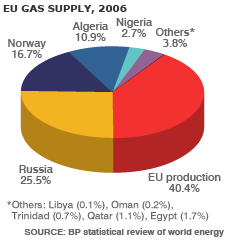 Dependence on Russia for gas:
100% dependent on Russia: Latvia, Slovakia, Finland, Estonia
More than 80% dependent: Bulgaria, Lithuania, Czech Republic
More than 60% dependent: Greece, Austria, Hungary
Source: European Council on Foreign Relations, 2006 figures
So what does this say about Russia's relationship with Europe? The terms monopoly, dependence and power are coming to mind. Last I checked, the United States has a similar dependence on Middle Eastern oil. Hm. Interesting.
Stay tuned for more news commentary and my upcoming list of concerns I would like to see addressed by the 44th President.
So, what have I failed to report on since the beginning of November? A continuously slumping economy which is beginning to look like a piece of silly putty hanging from a high rise that is slowly stretching toward the sidewalk, getting thinner and thinner...please excuse this horrible metaphor. Terrorist attacks in India, Obama introduces his cabinet, a massive stimulus plan and Reverend
So, as of Monday, President-Elect Obama has been in Washington waiting out Bush's last 12 days in office. He is not staying at the historic Blair House because apparently the entire premises will be occupied by former Australian Prime Minister John Howard who will be receiving the Presidential Medal of Freedom for...supporting Bush's preemptive war against Iraq. Excellent.
This little news story about Russia's natural gas supply to Europe came to my attention today and I find it to be quite interesting. This issue is not new, but due to an ongoing conflict between Russia's OAO Gazprom and Ukraine's NAK Naftogaz over export pricing and division, many European countries are now facing major gas cut-offs. On average, Europe depends on Russia for 25% of its gas but many countries depend on it for a much higher percentage.
 Dependence on Russia for gas:
100% dependent on Russia: Latvia, Slovakia, Finland, Estonia
More than 80% dependent: Bulgaria, Lithuania, Czech Republic
More than 60% dependent: Greece, Austria, Hungary
Source: European Council on Foreign Relations, 2006 figures
So what does this say about Russia's relationship with Europe? The terms monopoly, dependence and power are coming to mind. Last I checked, the United States has a similar dependence on Middle Eastern oil. Hm. Interesting.
Stay tuned for more news commentary and my upcoming list of concerns I would like to see addressed by the 44th President.
Tuesday, November 11, 2008
An Ally Against Hate.
I'm not Kieth Olberman's biggest fan, but I think that this speech that he gave last night to close his show, is very, very important. After being told by my own family members that Proposition 8 was not about homophobia or hatred, I encourage them to reconsider.
Wednesday, November 5, 2008
Obama 44th President of the United States of America
I have never been so proud of my country, and so disappointed in my state.
Sunday, November 2, 2008
Palin Pranked!
Okay. I really didn't want to stoop to the level of everyone else and post this...but I cracked my ass up listening.
Obama 08, No on Prop 8.
Go Vote.
Friday, October 31, 2008
U.S. Missile Strike in Pakistan
From NPR.com
Suspected U.S. missiles hit a house frequented by an Arab militant near the Afghan border Friday and killed 15 people, intelligence officials said, in the latest alleged American attack on targets inside Pakistan.
It was unclear if the Arab, identified as Abu Kasha Iraqi, was among those killed, the officials said on condition of anonymity because they were not authorized to speak to the media.
Suspected U.S. missile attacks have killed at least two senior al-Qaida commanders in Pakistan's wild border zone this year, putting some pressure on extremist groups accused of planning attacks in Afghanistan - and perhaps terror strikes in the West.
However, a marked uptick in their frequency over the last two months has badly strained America's seven-year alliance with Pakistan.
The strike Friday took place in Mir Ali village in North Waziristan, the officials said, citing reports from agents and informers in the area.
The United States rarely confirms or denies firing the missiles, which are launched from unnamed drones.
Okay. This is really starting to freak me out. Why isn't this making bigger news!? I don't know how many times I can say that. I mean, this is reminding me of the Cambodian invasion during Vietnam. When did the war in Iraq also become the war in Pakistan, and let's not forget about Syria. Our government is still refusing to acknowledge that we killed anyone there recently. BUT unlike the secret Cambodian invasion during Vietnam, this expansion of violence isn't a secret (at least some of it) and still, there are no protests. At least, not any that have been picked up by the news networks because we're constantly talking about this damn election.
On a similar note, this little tidbit is from DemocracyNow.org. It's good to know where our tax dollars are going.
A new government audit has found at least $6 billion in US taxpayer money has gone to private military and security companies operating in Iraq. The Special Inspector General for Iraq Reconstruction says that’s about 12 percent of the $50 billion in Iraq reconstruction money that has mostly flowed to American corporations. A recent internal report found the US has contracted at least 310 private security companies in Iraq. The most notorious of the companies, Blackwater Worldwide, has yet to face any charges for the September 2007 massacre of seventeen Iraqis in Baghdad’s Nissour Square.
Tuesday, October 28, 2008
One Final Week
Yes, it's coming down to the wire. It's to the point that there's a constant anxiety in the back of my head and I don't really realize what it's from until I stop for a second and remember that there's only a week left until this election. (I mean yes, it could be about the cost of my college education, or the economy, or my sadly empty refrigerator, or the unspeakable number of nuclear weapons floating around this planet....) but, one week and this additional drama will finally be over. I won't have to worry about our democracy being threatened by voter suppression, or the "accidental" acts of not mailing absentee ballots in swing states, or wondering if my absentee ballot will "accidentally" be lost in the mail.
"US Threatens Iraq Over Status Forces Agreement"
In news from Iraq, the McClatchy Newspapers report the US military has warned Iraq that it will shut down military operations and other vital services throughout the country on Jan. 1 if the Iraqi government doesn’t agree to a new agreement on the status of US forces. Many Iraqi politicians said they view the move as akin to political blackmail. In addition to halting all military actions, US forces would cease activities that support Iraq’s economy, educational sector and other areas.
It seemed like some of my worst fears were confirmed today as two neo-Nazis were arrested in Tennessee for making plans to assassinate Obama. The more I talk to people about this election, the more this fear keeps rearing its ugly head. Hatred is still running rampant in this country and it isn't helped by the increasing economic disparities between us. A United Nations report just came out highlighting that there are levels of inequality in cities like New York, Washington, Atlanta and New Orleans that rival the inequality seen in cities in Africa. They report that the US has the highest inequality and poverty after Mexico and Turkey. I feel like I need to pause for just a second to let those statistics sink in. It's an abomination is what it is. How did we get to a place where it became alright waste all of our resources on preemptive wars in the Middle East while our own people are living in such unspeakable inequality with one another.
As a follow up to my post yesterday about Syria, their Foreign Minister, Walid Al-Moualem, is accusing the US of terrorism and is warning of retaliation if the US continues to strike...and I continue to ask, why isn't this getting more press coverage? Shouldn't the headlines be shouting "Regional War in the Middle East?" But no, I had to scroll all the way to the bottom of the CNN home page to find a link to anything related to Syria.
From DemocracyNow! -
"US Threatens Iraq Over Status Forces Agreement"
In news from Iraq, the McClatchy Newspapers report the US military has warned Iraq that it will shut down military operations and other vital services throughout the country on Jan. 1 if the Iraqi government doesn’t agree to a new agreement on the status of US forces. Many Iraqi politicians said they view the move as akin to political blackmail. In addition to halting all military actions, US forces would cease activities that support Iraq’s economy, educational sector and other areas.
This is also being wildly under reported. This could potentially be the end of the war in Iraq. Unless I'm missing something...
And one more thing: Anyone else think it's just a little bit funny that a major Alaskan newspaper, the Anchorage Daily News, is endorsing Obama?
Sunday, October 26, 2008
US Attack On Syria
So I'm wondering...did they think that just because there are only 8 days until the election that we'd all be too preoccupied to notice that they're invading a new country?!
US helicopter-borne troops have carried out a raid inside Syria along the Iraqi border, killing eight people including four children, Syrian officials say.
The official Syrian news agency Sana said the raid took place in the Abu Kamal border area, in eastern Syria.
It said that American soldiers on four helicopters had stormed a building under construction on Sunday night.
The US says it is investigating. It has previously accused Syria of allowing foreign militants into Iraq.
Syria has summoned the US and Iraqi envoys in Damascus to protest at the raid.
"Syria condemns this aggressive act and holds American forces responsible for this aggression and all of its repercussions," a government official said.
If confirmed, the raid would be the first known attack by US forces inside Syrian territory, says BBC diplomatic correspondent Jonathan Marcus. - From BBC.com
So, the economy (not just our economy, the Global Economy) is collapsing, and it's not really making the news anymore, we're still in Iraq and Afghanistan, and it's really not making the news anymore...and now, we're attacking people in Syria? I mean I know it's important that the McCain campaign is paying Sarah Palin's makeup artist more than any one else on staff and that they spent $150,000 on her high school principal MILF outfits...if we have to talk about Palin at all, can't we talk about the fact that she's still under investigation in Alaska?
But, can't we, for once, talk about the stuff that really matters? How about the fact that a "suspected US strike" killed 20 people in Pakistan. I mean we're picking off the sovereignty of these countries like cucumber sandwiches at a lobbyist party. Anyone notice the nice drop in gas prices lately? I've actually been seeing them for under $3.00 (Amazing.) but OPEC just threw an emergency meeting to make this decline end. Yep.
I'm not really asking for a lot here...but sometimes getting anything of quality out of the media does seem like asking for snow in Southern California on Christmas.
Wednesday, October 22, 2008
Thursday, October 16, 2008
The Final 2008 Election Presidential Debate
As I was sitting on the bus today, allowing myself a brief respite from my textbooks and listening to Democracy Now, I realized that this was the last Presidential debate that my friends and I can play a drinking game to until 2012. I don't even know where I'm going to be in 2012. I could be out of the country....well, I could be out of the country a lot sooner than that depending on what happens on November 4. Just kidding...mostly.
Actually, there's a side note that I want to address. I'm tired of hearing conservatives criticize liberals for being "anti-American" for looking critically at our society and our government. People who take the time to think about what's going on, and who are paying attention to our country (and the world) are patriotic. Yes, I sit here behind the security of my computer and I say some things about conservatives (and sometimes liberals -- if I haven't yet, don't worry, I will) that are less than flattering, but the people I find to be truly anti-American are those who refuse to educate themselves about how our democracy works and then don't exercise their right to vote out of ignorance. When people complain about how neither major party represents them and that they are therefore not going to vote, they seem to either be unaware or indifferent to the fact that there are other parties to choose from. On my ballot, I can vote for the Green party, the Independent party, the Peace and Freedom party, and the Libertarian party in addition to the Democratic and Republican parties. I, for one, would love to see more parties with powerful roles in this country. I would love to see more of a Parliamentary system where there is a representational government based on popular vote. Anyway, I completely digressed. What I wanted to say was that just because I question my country doesn't mean that I am not incredibly proud of our diversity and our freedoms, and it doesn't mean that I don't get a little choked up when I hear the national anthem -- see, that elementary school brainwashing is very effective.
Alright. The debate. I think that John McCain improved upon his last performances, at least at the beginning. Although, I think it may be a little late at this point in the game. But we'll see. I'm not going to read through the transcript like I did for the last debate, so this commentary is going to be a bit more general.
There was a point, maybe about forty-five minutes in, where McCain seemed to get a little heated up over the negative campaigning and the subject of Bill Ayers. I've heard today, that he actually spent more time discussing this and other non-issues like ACORN than his economic policy. Correct me if I'm wrong.
It seems that every day McCain never fails to remind us that his campaign is running on fumes. The fumes of oil from offshore drilling that will take ten years to hit our markets. Or maybe he's running on nuclear waste? He may have made a point with his "zinger" that he is not George Bush (because if there was more than one GWB the earth would have probably already spun out of orbit and into the sun), but it's impossible to deny his voting record and his "don't bother me with the facts, I'm a gutsy from the heart maverick" attitude. If you were watching CNN last night, you probably noticed that most of the debate was broadcast with a split screen. For the first time, I was more captivated by the many facial expressions of John McCain that I was by that undecided Ohio voter opinion tracker. And yes, Obama had a few good ones too.
No matter how sincere McCain trained his voice to be, I think that his facial expressions really gave the game away. I have gotten a lot of amusement from the comparison between him and the neighborhood old scrooge who shuffles outside to get the newspaper and yells at the kids who walk on his lawn. Because really, McCain looked pretty incredulous during a good part of the debate, like he couldn't believe that Obama had the nerve to oppose him. This image, by the way, is really too good to pass up. Did anyone else catch this at the end of the debate? It was one of those moments when I wished that I had a Tivo hooked up, because I really wanted to hit rewind, multiple times.

It seems that every day McCain never fails to remind us that his campaign is running on fumes. The fumes of oil from offshore drilling that will take ten years to hit our markets. Or maybe he's running on nuclear waste? He may have made a point with his "zinger" that he is not George Bush (because if there was more than one GWB the earth would have probably already spun out of orbit and into the sun), but it's impossible to deny his voting record and his "don't bother me with the facts, I'm a gutsy from the heart maverick" attitude. If you were watching CNN last night, you probably noticed that most of the debate was broadcast with a split screen. For the first time, I was more captivated by the many facial expressions of John McCain that I was by that undecided Ohio voter opinion tracker. And yes, Obama had a few good ones too.
No matter how sincere McCain trained his voice to be, I think that his facial expressions really gave the game away. I have gotten a lot of amusement from the comparison between him and the neighborhood old scrooge who shuffles outside to get the newspaper and yells at the kids who walk on his lawn. Because really, McCain looked pretty incredulous during a good part of the debate, like he couldn't believe that Obama had the nerve to oppose him. This image, by the way, is really too good to pass up. Did anyone else catch this at the end of the debate? It was one of those moments when I wished that I had a Tivo hooked up, because I really wanted to hit rewind, multiple times.

That other star of last night's debate, Joe the Plumber, what about him? I'm now considering going into the plumbing industry since he must be making over $250,000 a year, because according to the Joe the Plumber story, he would be losing big with Obama's tax plan...and (I swear I've already been over this) with Obama's tax plan, if you're making under $250,000 a year, your taxes are not going up. So yes, my new vocation, plumber's school. Why waste my time with this whole University education thing?
I'm sure there are a lot of other things to be commented on after last night's debate. But to be quite honest, I'm just about ready for this election to be over. I've cast my ballot, my vote is in, and I encourage all others to do the same, as soon as you can. And unlike McCain tonight at the Alfred E. Smith Memorial Foundation Dinner, I wish both candidates luck. All I'm really asking for, is a fair election.
I'll be back early next week for an update on national and international affairs. Enjoy the weekend!
Thursday, October 9, 2008
Second Presidential Debate
My friends...alright, yes, I know I'm a little slow on the updates, and we've already moved on to the crumbling global economy and the fact that the DOW closed under 9,000 points today. Did everyone hear about the audience members at the Republican rallies, calling Obama a terrorist and saying "Kill him!"? Yeah. I'm not even going to go there.
We've already heard all of the pundits' reactions, we've already gossiped with our friends and singled someone out as "That One" just to get a laugh. We're all awaiting the report on Alaska's Sarah Palin investigation, which is to be released tomorrow, and wondering how much voter registration fraud has happened in our districts. I'm personally wondering if I'll be recieving my absentee ballot and voter's guide on time. But, despite all of that, I'm going to return to Tuesday night's debate and go through the transcript so that some of the statements made get the attention they deserve. And by attention, I generally mean criticism, because who really has time for anything other than attack ads these days?
In McCain's response to the first question, which addressed the current economic disaster, he said that "we've got to stop sending $700 billion a year to countries that don't want us very --- like us very much." He then went on to talk about the $10 trillion dollar debt. Is it just me, or has that debt he's talking about largely been caused by the war in Iraq, the war that John McCain has supported from day 1 and continues to support? Are we not sending billions of dollars into a country whose people want us to get the hell out? Then he mentioned reform to bring "peace in the world." Am I crazy, or did McCain just contradict himself within the first two minutes of the debate? He then made his, not Obama's or Bush's, but his, big economic proposal, which is to order the secretary of the treasury to buy up the bad home loan mortgages and renegotiate new values for those homes...which he admits will be very expensive....but he promises not to raise taxes for anyone. Hm. Interesting.
I'm a big fan of Bill Maher's show Real Time on HBO. At the end of every show he does his "New Rules" section, which is exactly as it sounds. I think I might throw in some of my own New Rules as I go through this. 1) New Rule: John McCain must stop saying that he suspended his campaign in order to go to Washington and pass the rescue plan aka bailout bill. His campaign was still airing commercials on TV and taking online donations. On top of that, he continued on his campaign before the bailout was passed.
Obama and McCain both reiterrate the same messages that we've been hearing for weeks. Obama focuses on the middle class, health care, education, change, change, and change. McCain repeatedly talks about stabilizing the housing market (well I guess he hasn't been saying that for weeks, since he only recently realized we have a problem, but I think he's very excited about his new idea). He also repeatedly mentions his history of bipartisanship in questions completely unrelated to his answers.
2) New Rule: If John McCain wants to discuss Obama's earmarks (which I think is a fair and valid point), he must also discuss Sarah Palin's earmakrs as governor of Alaska. He must also explain why he voted for the $700 billion dollar bailout bill when an additional $110 billion of pork was written in to sweeten it up.
McCain brings up a good point in discussing Obama's small business tax increases. This is definitely a point that the Obama campaign doesn't want to draw a lot of attention to. Raising taxes on buisinesses does make products more expensive for us consumers. But funding for things like health care has to come from somewhere...and hence, a key economic difference between a Democrat and a Republican... However. It is difficult to say how many small businesses will actually be affected by Obama's tax plan due to the different ways in which people file their income taxes. So, McCain's assertion that taxes will increase on 50 percent of small business revenue is very misleading, if not entirely false. It is unlikely that taxes for more than a few percent of small businesses will actually increase.
Speaking of health care. I wonder how all those voters in Florida are feeling about McCain's position on privatizing health care and the possibility of losing Medicare? Speaking of Florida...

One thing I think we were all looking for in this debate was for McCain to address some of the issues that have been taking the spotlight in his most recent attack ads...Bill Ayers for example. But it seems as if McCain has a more difficult time bringing up ridiculous accusations when he actually has to face Obama. In fact, he seems to have a difficult time looking at Obama at all.
Sunday, October 5, 2008
The VP Debate Followup + the Economy
I don't really think that this video needs an introduction. I have a feeling that most cognizant Americans will have seen or heard about it by tomorrow, so I figured I'd just keep up with the latest trends. Maybe one day that will make me....trendy. Unlikely.
In my last post I said that I would talk about the 700 billion dollar Wall Street bail out plan that was passed last Friday by over 2/3 of the House and Senate. I'm going to just say, right off the bat, that economics are not my strong suit. (However, I am also not running for president...but maybe I could be?) It has been a long two weeks for any American with a stake in the stock market...and the Americans like me who don't...okay, it's just been a long two weeks...two months...eight years. We're all affected. Unemployment is increasing faster than it has in five years. The Dow Jones lost 777.68 points on Monday when the House rejected the first bailout bill. This is the largest one day loss in history. Even after the House passed the revised bill on Friday, the stock market still lost 157 points.
So what does this mean? You're damned if you do, you're damned if you don't? The thing is, no one seems to know exactly what to do or what is going to happen. Even after listening to hours of radio and news broadcasts and reading dozens of articles of "expert analysis," I still find the subject to be confusing; and I am not in the least bit reassured that this bill is going to actually benefit me or my country. The "economic recovery plan" is by no means a guarantee. In fact, the $700 billion was just a randomly picked number. Yup. It just sounded good.
I know that the big buzzword this election year has been Change. It has been reiterated so frequently that it has become just more empty rhetoric, an optimistic platitude. However, when it came to voting for this bill, both Senator Obama and Senator McCain were in full support. How exactly does their support for bailing out a failed system reflect their willingness for change in Washington? Especially after packing it with pork in order for Congress to pass it? We're talking tax cuts for makers of wooden arrows and worsted wool, racetrack operators, film producers and rum importers. Seriously. If I were a politician, I would be thinking twice before jumping onto the back of a plan that was so heavily courted by the Bush Administration (who gave us nonexistent WMDs, Mike Brown, Scooter Libby, Alberto Gonzales, etc.). Bush appeared on the White House steps Friday just to congratulate Congress on a job well done.
However, I am certainly not a politician or an economist. I can only come to my own conclusions after becoming as informed as my free time allows...and after this week I know that I will be making very careful choices when it comes to which Congressional Representative will get my vote this November.
Just to note: Tuesday is the second Presidential debate in which the candidates will be taking questions from the audience...as far as I can tell...information is a little scant. I will be working that night and my response will be coming as quickly as I can sit down to watch.
In my last post I said that I would talk about the 700 billion dollar Wall Street bail out plan that was passed last Friday by over 2/3 of the House and Senate. I'm going to just say, right off the bat, that economics are not my strong suit. (However, I am also not running for president...but maybe I could be?) It has been a long two weeks for any American with a stake in the stock market...and the Americans like me who don't...okay, it's just been a long two weeks...two months...eight years. We're all affected. Unemployment is increasing faster than it has in five years. The Dow Jones lost 777.68 points on Monday when the House rejected the first bailout bill. This is the largest one day loss in history. Even after the House passed the revised bill on Friday, the stock market still lost 157 points.
So what does this mean? You're damned if you do, you're damned if you don't? The thing is, no one seems to know exactly what to do or what is going to happen. Even after listening to hours of radio and news broadcasts and reading dozens of articles of "expert analysis," I still find the subject to be confusing; and I am not in the least bit reassured that this bill is going to actually benefit me or my country. The "economic recovery plan" is by no means a guarantee. In fact, the $700 billion was just a randomly picked number. Yup. It just sounded good.
I know that the big buzzword this election year has been Change. It has been reiterated so frequently that it has become just more empty rhetoric, an optimistic platitude. However, when it came to voting for this bill, both Senator Obama and Senator McCain were in full support. How exactly does their support for bailing out a failed system reflect their willingness for change in Washington? Especially after packing it with pork in order for Congress to pass it? We're talking tax cuts for makers of wooden arrows and worsted wool, racetrack operators, film producers and rum importers. Seriously. If I were a politician, I would be thinking twice before jumping onto the back of a plan that was so heavily courted by the Bush Administration (who gave us nonexistent WMDs, Mike Brown, Scooter Libby, Alberto Gonzales, etc.). Bush appeared on the White House steps Friday just to congratulate Congress on a job well done.
However, I am certainly not a politician or an economist. I can only come to my own conclusions after becoming as informed as my free time allows...and after this week I know that I will be making very careful choices when it comes to which Congressional Representative will get my vote this November.
Just to note: Tuesday is the second Presidential debate in which the candidates will be taking questions from the audience...as far as I can tell...information is a little scant. I will be working that night and my response will be coming as quickly as I can sit down to watch.
Saturday, October 4, 2008
The Real Place for Politics
It's being called the most important election in recent US history, at least by those in the running. While president George W. Bush has been president I have accomplished many things. 12 year old molars, the first kiss in the back of a greasy movie theater where you suddenly have a popcorn and Slurpee tongue reaching down your throat, graduating from training bras and the discovery of the thong, one week of AP physics, a sober prom, a short film, defeating Costa Rican cockroaches, the blog. The list goes on. On the top of this list though, is realizing that the rapidly changing world in which we live will never be the same as it was during my childhood of the 1990s. I have often heard it said that my generation, generation Y, is indifferent to the world outside of our cell phones, Facebooks, and iPods. I would like to take a brief moment to say that this is not entirely true: if the economy crashes and the cost of power becomes so extreme that we can't recharge our iPods and connect to the Internet to access our Facebooks...I think you'll find that a lot of my fellow generation Yers will be at the forefront of political action and agenda.
This week there was one of the most highly anticipated Vice Presidential debates of all time in which 70 million people tuned in to watch. Republican Governor, Sarah Palin, and Democrat Joe Biden took the stage for an hour and a half of uninterrupted political discussion...I mean debate. Why did so many people decide to spend their Thursday night watching politics instead of The Office? Well, I think it was for the same reason that people enjoy watching NASCAR races or Project Runway. There's always that possibility that someone is going to go into a tailspin and end up on an ambulance for more than just a bruised ego. I know that when I turned on my TV, I was awaiting Sarah Palin's next big verbal tailspin as much as I was hoping for Joe Biden to lose his cool and tell Ms. Palin to get off the stage. Well, like so many other Americans, I have to say that I was a little disappointed by the lack of any dramatic or embarrassing episodes.
Sarah Palin gave us an hour and a half of well rehearsed folksy charm *wink* and Joe Biden gave us straightforward, fact based, practiced politician style prose. I think while it's safe to say that Biden easilly came out on top, it was interesting to hear Palin twist her answers into something relating to her expertise in energy policy and the overall mavericky nature of both herself and John McCain. Biden reminded us that he is able to count to at least two, and he also reinforced McCain's history of deregulation and the current financial crisis which, as we all know, McCain was a little slow to get on board with ("Still, the fundamentals of our economy are strong!").
I want to call special attention to a few facts that Sarah Palin seemed to find it necessary change...or else was just unaware when she was speaking incorrectly. As far as I know, she beat out Biden on the creation of factual fallacies. (However I will be the first to admit that I pay more attention to news sources that are more likely to talk about Sarah Palin's blunders than Joe Biden's --- at least I am able to name which news sources I utilize, and no, it's not "All of them." They include: The New York Times, The Los Angeles Times, The Wall Street Journal, The Guardian, Democracy Now, NPR, BBC, CNN, Fox, MSNBC.) I think I'll go Biden style and number my responses to this. 1) The troop levels in Iraq are not lower than they were before the surge. 2) Barack Obama did not vote to raise taxes for people making $42,000 a year or more. 3) The General in Afghanistan is David McKiernan not Civil War General George McClellan. 4) McCain does not, in fact, want to allow bankruptcy judges rewrite mortgages.
Phew. Although I think there were a few more moments to be commented on, I'll leave it at that. Y'know, it's not that I can say I personally dislike Sarah Palin. I've never met her and it would be presumptuous of me to assume that she and I would not get along. In fact, as long as we agreed to not discuss politics, I'm sure she could teach me a few things about decapitating moose. What I can say though, is that John McCain has given me a very serious reason to question his ability to make sound decisions by placing this self-proclaimed pit bull with lipstick hockey-mom a heartbeat away from that big chair in the Oval Office. I'm not even sure if I would want this woman running my child's PTA, especially if she were to tell my daughter that she had to pay for her own rape kit in a medical examination.
More to come on that $700 billion bailout when this full-time student with a part-time job has made more time for this full-time hobby -- because I, unlike some politicians we all know, can walk and chew gum...at the same time.
This week there was one of the most highly anticipated Vice Presidential debates of all time in which 70 million people tuned in to watch. Republican Governor, Sarah Palin, and Democrat Joe Biden took the stage for an hour and a half of uninterrupted political discussion...I mean debate. Why did so many people decide to spend their Thursday night watching politics instead of The Office? Well, I think it was for the same reason that people enjoy watching NASCAR races or Project Runway. There's always that possibility that someone is going to go into a tailspin and end up on an ambulance for more than just a bruised ego. I know that when I turned on my TV, I was awaiting Sarah Palin's next big verbal tailspin as much as I was hoping for Joe Biden to lose his cool and tell Ms. Palin to get off the stage. Well, like so many other Americans, I have to say that I was a little disappointed by the lack of any dramatic or embarrassing episodes.
Sarah Palin gave us an hour and a half of well rehearsed folksy charm *wink* and Joe Biden gave us straightforward, fact based, practiced politician style prose. I think while it's safe to say that Biden easilly came out on top, it was interesting to hear Palin twist her answers into something relating to her expertise in energy policy and the overall mavericky nature of both herself and John McCain. Biden reminded us that he is able to count to at least two, and he also reinforced McCain's history of deregulation and the current financial crisis which, as we all know, McCain was a little slow to get on board with ("Still, the fundamentals of our economy are strong!").
I want to call special attention to a few facts that Sarah Palin seemed to find it necessary change...or else was just unaware when she was speaking incorrectly. As far as I know, she beat out Biden on the creation of factual fallacies. (However I will be the first to admit that I pay more attention to news sources that are more likely to talk about Sarah Palin's blunders than Joe Biden's --- at least I am able to name which news sources I utilize, and no, it's not "All of them." They include: The New York Times, The Los Angeles Times, The Wall Street Journal, The Guardian, Democracy Now, NPR, BBC, CNN, Fox, MSNBC.) I think I'll go Biden style and number my responses to this. 1) The troop levels in Iraq are not lower than they were before the surge. 2) Barack Obama did not vote to raise taxes for people making $42,000 a year or more. 3) The General in Afghanistan is David McKiernan not Civil War General George McClellan. 4) McCain does not, in fact, want to allow bankruptcy judges rewrite mortgages.
Phew. Although I think there were a few more moments to be commented on, I'll leave it at that. Y'know, it's not that I can say I personally dislike Sarah Palin. I've never met her and it would be presumptuous of me to assume that she and I would not get along. In fact, as long as we agreed to not discuss politics, I'm sure she could teach me a few things about decapitating moose. What I can say though, is that John McCain has given me a very serious reason to question his ability to make sound decisions by placing this self-proclaimed pit bull with lipstick hockey-mom a heartbeat away from that big chair in the Oval Office. I'm not even sure if I would want this woman running my child's PTA, especially if she were to tell my daughter that she had to pay for her own rape kit in a medical examination.
More to come on that $700 billion bailout when this full-time student with a part-time job has made more time for this full-time hobby -- because I, unlike some politicians we all know, can walk and chew gum...at the same time.
Subscribe to:
Posts (Atom)